
The biggest takeaway for me wasn’t AI but the danger of inertia.
Cannes Lions is always a spectacle.
I used to attend as part of a large agency network, complete with an air-conditioned base to retreat to. For the second year running, though, I came with Patrick Ryan, moving between panels, conversations, meetings and the occasional opportunity to sit down.
There is still plenty of uncertainty across the industry (and the world), but uncertainty is also creating a choice. Some businesses are waiting, while others are investing, experimenting and reshaping how they operate despite not having every answer.
I’ve tried to distil the conversations, panels and sentiment into five themes. Enjoy!
This should surprise nobody, but the conversation matured a lot from last year.
2025 was dominated by more fear and speculation. This year felt different as the volume of AI discussion hasn’t decreased, but the quality has improved. People are moving beyond experimentation and are applying AI with much more intent.
One of the most useful and promising perspectives came from Jules Love at Spark AI, who compared the moment we’re in to the evolution of accountancy. The calculator didn’t replace accountants. Excel didn’t replace accountants. Integrated software platforms didn’t replace accountants. Each innovation changed the profession and raised expectations of what people could deliver.
We’re living through the same transition now.
What stood out in Cannes was that more people were asking how they could integrate it into their business in a way that genuinely creates value beyond pure efficiencies.
Building on the AI point, the legal questions are becoming harder to ignore.
Who owns the output? Who is accountable when something goes wrong at scale? What information is your business putting into open-source models?
These discussions are happening everywhere, from New York to Germany and beyond. Regulation is moving at different speeds across different markets while the technology continues to accelerate.
Businesses waiting for perfect clarity may find themselves exposed. A little caution, good governance and plenty of common sense still seem to go a long way.
Trust felt like the thread running through almost every conversation. It’s important at every level and type of business.
Consumers are questioning what is real and what has been generated. Brands are balancing speed and scale with authenticity. Agencies continue to face scrutiny around transparency, fees and the value they create. Media owners are under pressure to reduce wastage and demonstrate effectiveness.
This is before we even get into disinformation and misinformation.
Creating trust takes time, and there are businesses who know that and who operate transparently through their actions rather than relying on claims or stunt-like marketing tactics. Not to name any names!
Subscribe
This was particularly noticeable among agencies.
Everyone talks about differentiation, yet many businesses still sound remarkably similar.
Clients we spoke to wanted clarity and trust, yet many agencies continue to be distracted chasing the latest trend or competitor, rather than defining exactly who they are, what they believe and where they want to go.
A clear proposition has commercial impact. It shapes how prospects perceive you, how clients remember you and ultimately whether they choose to work with you.
Hearing from businesses who were consistent and knew what they stood for made a world of difference out in Cannes.
Perhaps the most concerning conversation of the week was around the future talent pipeline.
There is growing anxiety about who enters the industry next and what opportunities will exist when they get here.
While technology continues to shape the future, it was interesting how many senior leaders eventually came back to the importance of people. It’s a strange dichtomy!
The industry is embracing AI because the efficiency gains are obvious. Investment is naturally following the opportunity.
At the same time, advertising is evolving rapidly. Traditional businesses are adapting their operating models. Agentic commerce, automation and AI-powered workflows featured heavily in conversations about future growth.
What remains less clear is how the next generation develops the skills that traditionally came from learning on the job. If entry-level tasks disappear, where does experience come from?
Like many of the themes discussed throughout the week, this feels like a challenge that can easily be pushed into the future. Yet the longer it waits, the harder it becomes to solve.
It’s a challenge made for creative people. If there’s enough will, there’s a way.
We’re also hoping to play a small part ourselves with a workshop programme this summer, so keep your eyes peeled.
For all its flaws and cost, Cannes still acts as one of the best barometers of where the industry is heading. There are few opportunities where so many people come together to debate the biggest challenges while having a bit of fun along the way.
The biggest takeaway for me wasn’t AI but the danger of inertia.
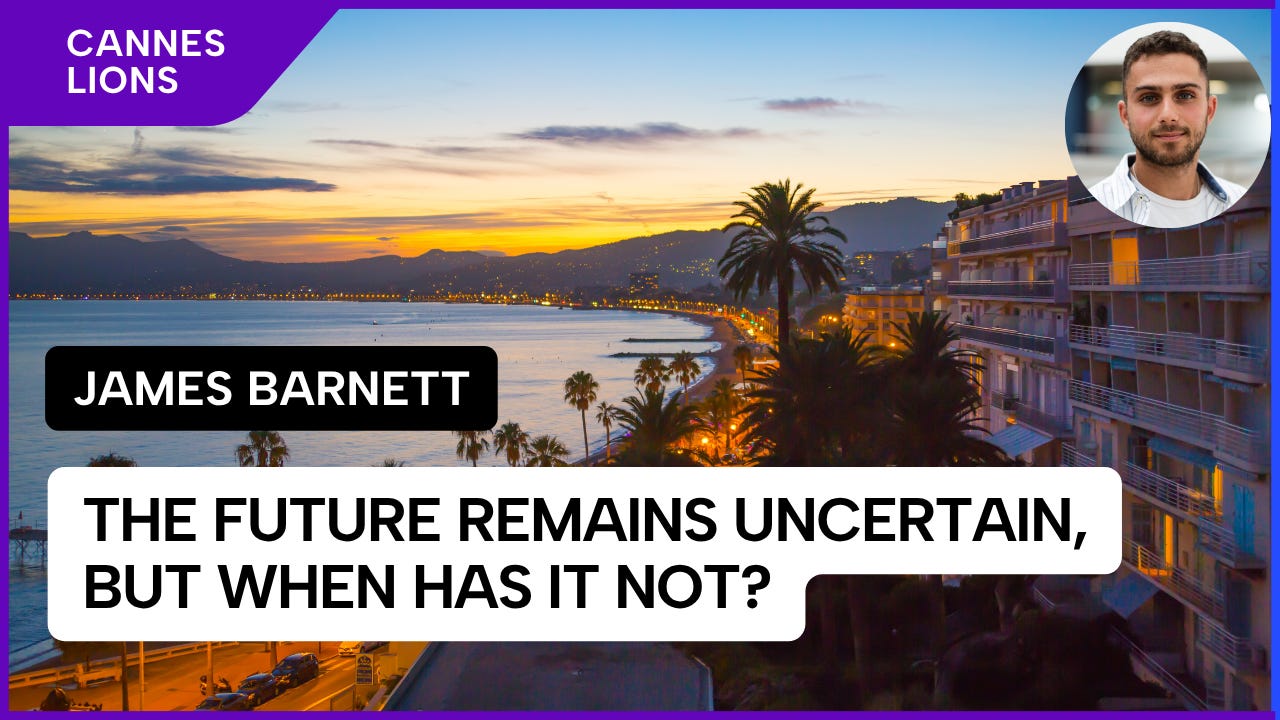
The future remains uncertain, but when has it not?

stay in the know

.png)
Has AI turned us blind?
⏱
4 min

When will we stop mistaking channels for strategy?
⏱
6 min
An excellent marketing strategy never came from a prompt
⏱
6 min
Your marketing shouldn’t suffer like your New Year’s Resolutions
⏱
6 min
Built for service-based businesses who want to be the brand people trust.
© 2026 Realview Marketing Ltd.
Website design by Wiggle Creative