
When it comes to new ideas, processes or tech, learning to 'walk the walk' allows you to 'talk the talk'.
Every week, there’s a new tool, a new framework, or a new trend we’re told we must adopt to prepare for the future. It may be a new CRM, new AI workflows, new productivity stacks, new “operating systems for business”.
For Founders and business owners, it can quickly become overwhelming.
Likewise, for us as an agency, it would be incredibly easy for us to recommend something that sounds smart in theory before we’ve actually lived it ourselves.
But theory and reality are two very different things.
Before offering a new, shiny solution to a client, we must ask: Can we prove it out ourselves?
We try to follow a simple principle: test in the real world before scaling.
Here’s the three key rules to how we think about it:
A highly practical example for us at Real View has been how we manage projects and client work inside Notion.
Previously, each client had their own workspace. Each workspace had its own calendars, documents, and project information. At first, this seemed logical. It felt clean and organised.
But as we partnered and grew with more clients, it quickly became harder to manage. We were jumping between workspaces, keeping track of multiple calendars, duplicating documents, and creating unnecessary friction for the team.
We needed to stay flexible and evolve with our clients and new opportunities, so we decided to rethink how everything was structured.
Instead of maintaining separate workspaces, we began testing a centralised system internally. Each client now has their own pages, tone of voice sections, project boards, and calendars within one shared workspace linked to our recorded Otter meetings. Clients can still access their own areas, but the Real View team can see everything in one place, allowing us to seamlessly embed ourselves in teams.
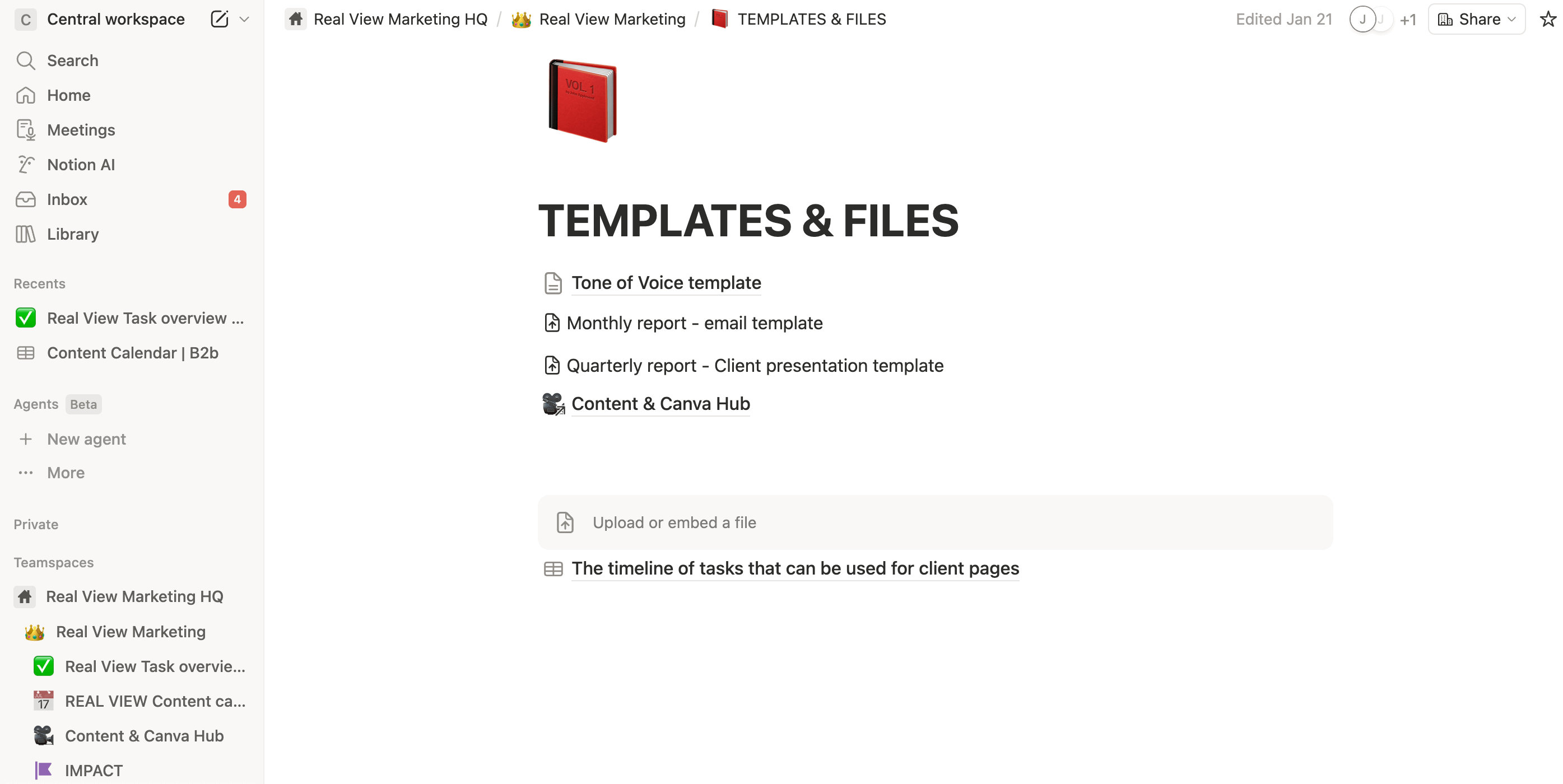
It took some trial and error to get it right. Workflows needed adjusting. Permissions had to be refined and templates evolved over time.
However, by testing and adjusting the system internally first, we were able to build something that works far better for everyone.
We’ve been running things this new way for around four months now. It’s far easier to manage and helps us deliver high-quality work without jumping between workspaces, duplicating files, or getting lost in an unnecessary Notion maze.
The Notion example is a small one, but it reinforces a wider lesson about how businesses can operate.
It can be easy to act like a magpie when new tools and trends appear. Something shiny catches our eye, and suddenly we’re tempted to adopt it straight away.
But in an industry filled with constant distractions, discipline and patience will always beat chasing the next trend.
Testing ideas within your own business first gives you the time to refine them properly. You discover where the friction actually sits. You see what integrates well with the rest of your stack. And most importantly, you learn whether the change genuinely improves how your team operates.
When you eventually introduce it to clients, you’re sharing something that is proven to work in practice.
Not theory.
It’s also why we focus heavily on applying the same thinking to our own marketing. If we’re advising clients on systems, workflows, or content strategies, we believe we should be doing the same ourselves.
There’s only so much one can implement, but a focus on walking the walk is essential.

stay in the know

Built for service-based businesses who want to be the brand people trust.
© 2026 Realview Marketing Ltd.
Website design by Wiggle Creative
