
Why real strategy starts with audience insight, not AI-generated plans.
Anyone can ‘make’ a marketing strategy.
You open AI, describe your business in a few sentences, ask for a go-to-market plan, and receive something coherent.
The issue is it’s entirely devoid of the thinking that actually makes strategy work.
There needs to be a genuine understanding of the audience and an insightful human perspective on what the business actually stands for and why that should matter.
Understanding who you are trying to reach is an ongoing discipline.
Your business and audience are not fixed entities, though. What an audience responds to evolves constantly, and the only way to stay ahead of that is to build genuine feedback loops into the way you work and your marketing plan.
Two examples from current client work illustrate this.
The first is a SaaS business where the original strategy was built around functionality. The positioning centred on time-saving: here is what the platform does, here is the manual effort it removes, here is what you get back.
What the audience response showed us over several months was that the fear-based angle landed considerably better. Security risks and the consequences of continuing to do nothing proved more motivating than the appeal of efficiency. The messaging shifted to reflect that, and so did the results.
The second is a consultancy where the original services have been substantially adapted since we started working together. That gap only becomes visible through consistent listening as we took a more land and expand route, compared to a meatier sell.
Once the audience insight and competitive picture are in place, the strategic questions become considerably easier to answer.
Channels are the last part, not the first. Treating them as the starting point is one of the more expensive mistakes a business can make, and it is a very easy mistake to make when an AI tool is happy to jump straight to a posting schedule without ever thinking about the foundations behind it.
AI is genuinely useful in the planning process. It can help organise thinking, stress-test logic, identify gaps in a framework, and speed up the parts of strategy work that are structural rather than substantive. Using it to do the thinking itself, particularly the audience insight and the narrative, produces boring sameness.
A surprising number of businesses, including some with substantial budgets and reasonably mature marketing functions, have never properly defined what they are trying to achieve or how they will know if they are getting there. Without clear goals, there is no basis for making decisions and no true way to assess whether something is working.
KPIs do not need to be elaborate, but need to capture what an audience really thinks. They need to be meaningful and genuinely connected to the commercial outcomes the business is working towards. Impressions and follower counts tell you something, but not enough to make good decisions with. We like to look at more trust-based metrics that take into account qualitative and quantitative aspects. We’re now looking to refine our marketing and new business strategy so we are best servicing our ICP.
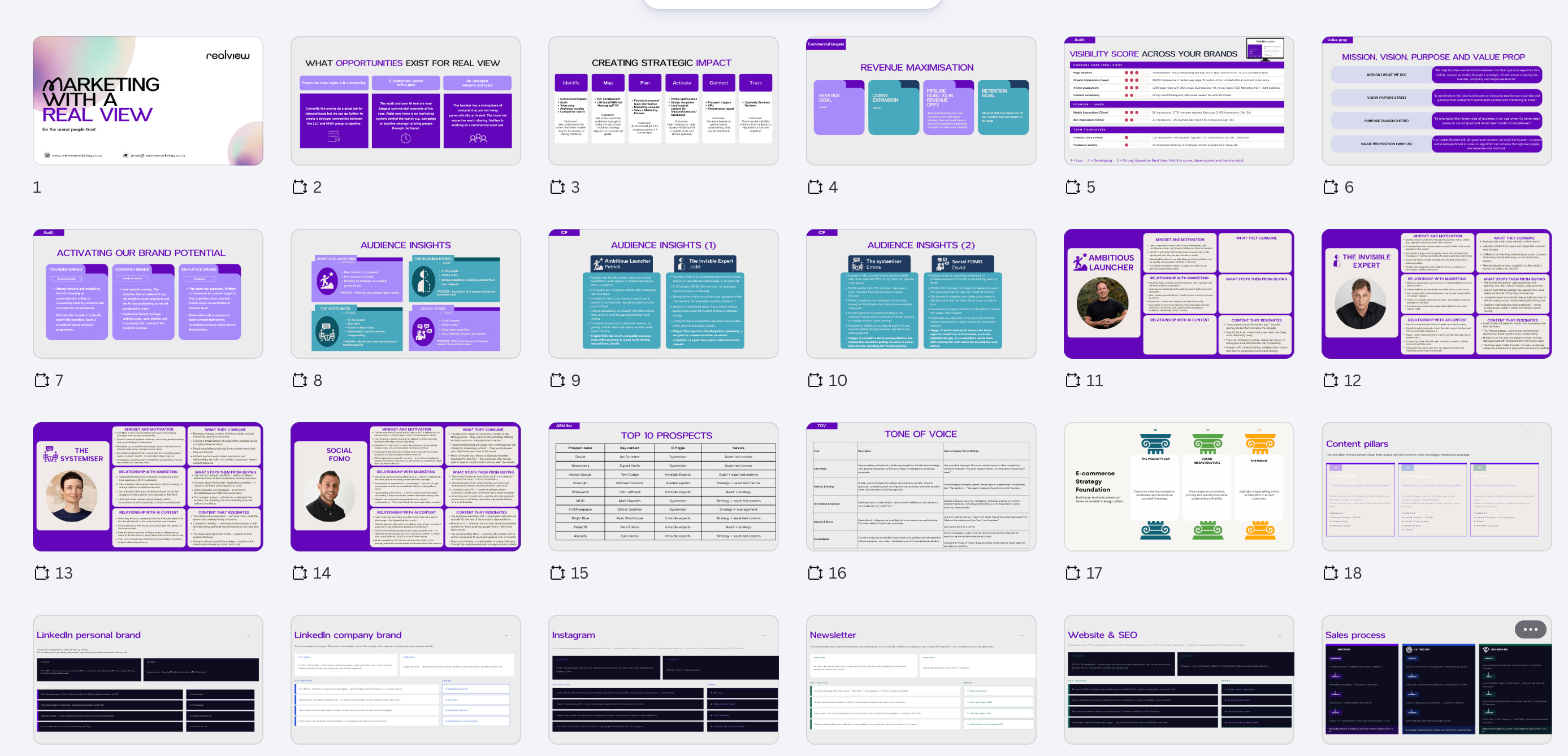
A good marketing strategy is not something a prompt can produce. It requires detail and experience from people who pay consistent attention to its audience and produce a consistent and accountable plan to reach people by providing true value.
Running an agency, writing about B2B marketing, and building in public. If any of this resonated, I would love to hear what you are working through on your end.

stay in the know

.png)
Has AI turned us blind?
⏱
4 min

Inertia is the real enemy: learnings from Cannes Lions
⏱
4 min

When will we stop mistaking channels for strategy?
⏱
6 min
Your marketing shouldn’t suffer like your New Year’s Resolutions
⏱
6 min
Built for service-based businesses who want to be the brand people trust.
© 2026 Realview Marketing Ltd.
Website design by Wiggle Creative